Introduction: why custom SBCs matter in industrial OEM projects
Why standard SBCs may not fit long-lifecycle products
Off-the-shelf single board computers can be a fast way to prove software, UI flows, or connectivity early on. But many industrial OEM products aren’t built like prototypes. They ship for years, get serviced in the field, and live inside enclosures with tight constraints on connectors, thermals, and wiring.
In long-lifecycle products, an “almost fits” board can create long-term friction:
Interfaces don’t line up with your display, touch, PLC connectivity, or sensor wiring.
Mechanical layout forces awkward cable routing, bracketry, or rework in the enclosure.
Thermal behavior changes once the board is inside a sealed housing.
Supply and revision control depends on the board vendor’s roadmap, not your product roadmap.
If your product lifecycle is 5–10 years, change control becomes a core engineering activity. Even small revisions can trigger downstream revalidation. The discipline of assessing changes by form, fit, and function is a common way to decide whether a change is a simple revision or a requalification event (see Arena Solutions’ overview of form, fit, function (FFF)).
Why custom SBCs are considered in B2B applications
Custom single board computers (custom SBCs) are usually considered when requirements are stable and teams want tighter alignment between the computing platform and the product’s real constraints.
Typical triggers in industrial B2B projects include specific I/O and field interfaces (RS485, CAN, isolated digital I/O), specific display/touch requirements (LVDS, MIPI DSI, eDP, USB or I2C touch), a defined power input range and protection strategy, and mechanical constraints such as mounting holes, connector orientation, and cable routing.
Custom doesn’t automatically mean “more advanced.” It means the board is designed to remove unnecessary parts, integrate the parts you actually need, and reduce system-level integration risk.
Who this guide is for
This guide is for industrial OEM and ODM decision teams—hardware/embedded engineers, product managers, procurement, and program owners responsible for platform selection.
It’s written to support evaluation discussions: what to compare, what to cost, and what to validate before committing.
Quick answer: when are custom single board computers worth it?
Custom SBCs are usually worth considering when requirements are stable
A custom SBC is usually worth serious consideration when most of the following are true:
Requirements are stable (CPU class, OS, display/touch, critical I/O).
Volume is predictable and the lifecycle is multi-year.
You need a specific connector layout, board outline, or reduced cabling.
Integration complexity is becoming a schedule or reliability risk.
You want stronger control over BOM, PCNs, alternates, and platform evolution.
A good mental model: you’re paying engineering effort (NRE) to reduce recurring integration cost and long-term risk.
Standard SBCs may be better for fast prototyping
An off-the-shelf SBC is often the right move when you’re validating early software/UX, volume is low or uncertain, or requirements are still changing (especially display, touch, and OS choices).
In this stage, time-to-first-boot matters more than perfect connector placement.
SOM + carrier board may be better for faster platform reuse
A SOM (system on module) approach is a practical middle path when you want a proven compute core, faster development than a full custom SBC, a carrier board tailored to your I/O/power/mechanical constraints, and reuse across multiple products.
This is one reason many industrial teams view SOM + carrier as a scalable platform strategy. If you’re comparing these approaches in a project today, Renesas’ discussion of “make or buy” modules and SBCs is a useful framing reference (see Renesas’ design-cycle discussion).
What is a custom single board computer?
A custom single board computer is an embedded motherboard designed around your product requirements. Instead of adapting your enclosure and wiring to a standard board, you specify the board outline, connectors, I/O mix, power entry, and lifecycle controls you plan to ship.
Typical customization areas include CPU/SoC, memory and storage, I/O (Ethernet/UART/RS485/CAN/USB/GPIO), display and touch interfaces (MIPI DSI/LVDS/eDP/HDMI; USB or I2C touch), power protection, and mechanical layout.
Custom SBC vs off-the-shelf SBC
A custom SBC aims to eliminate adapters, awkward cabling, and mechanical compromises when requirements are stable and the product has a multi-year lifecycle.
Custom SBC vs SOM with carrier board
Both approaches can be “custom,” but they split risk differently:
Custom SBC (one-board): full control and optimization, but you own the entire design and validation effort.
SOM + carrier: a pre-validated compute module plus a tailored carrier board, often reducing high-speed layout risk and speeding development.
Mouser’s overview is a practical starting point for this architecture-level comparison (see Mouser’s SOM and SBC evaluation PDF).
Why industrial applications often need hardware-level customization
Industrial products often can’t tolerate workaround-heavy designs. Connector placement, service access, EMI behavior, thermal paths, and long-term change control tend to matter as much as compute performance.
When off-the-shelf SBCs fall short
Off-the-shelf SBCs often fall short when you need a specific combination of display/touch, industrial I/O, power protection, and enclosure-driven mechanical/thermal constraints.
Common gaps include:
display interfaces (MIPI DSI, LVDS, eDP) and a defined cable/connector strategy
touch integration (USB vs I2C, controller compatibility)
cameras/sensors (MIPI CSI, I2C)
industrial connectivity (RS485, CAN, extra UARTs/GPIO)
wide-range DC input and protection (surge/ESD/reverse polarity)
predictable thermal behavior inside a sealed enclosure
Hidden costs from adapters, extra cables, and redesign
A standard board may look cheaper per unit, but workarounds add system cost: adapter boards/harnesses, extra connectors, enclosure rework, and more validation time when revisions occur.
Long-term supply and lifecycle risks
Long-lifecycle products can be disrupted by board revisions, EOL events, and platform changes that don’t align with your roadmap. Promwad’s overview of long-lifecycle embedded design is a useful reference (see Promwad’s guide on designing long-lifecycle embedded systems).
When a standard SBC may still be the better choice
A standard SBC is often better for early prototyping, low/uncertain volume, or when you can accept the board’s mechanical impact and prioritize fastest time-to-market.
Key benefits of custom SBCs for B2B applications
A custom SBC is valuable when it removes integration risk you’d otherwise carry in harnesses, adapters, and enclosure rework.
Key benefits typically include:
I/O that matches the real product: display/touch, sensors, and industrial interfaces designed for the intended stack.
Better mechanical fit: board outline, mounting, connector orientation, and service access aligned to the enclosure.
Fewer cables and connectors: simpler assembly and fewer failure points.
Reliability built in: power protection and thermal design based on the real environment, not a bench setup.
Lifecycle control: clearer BOM ownership, alternate-part planning, and revision discipline aligned to your roadmap.
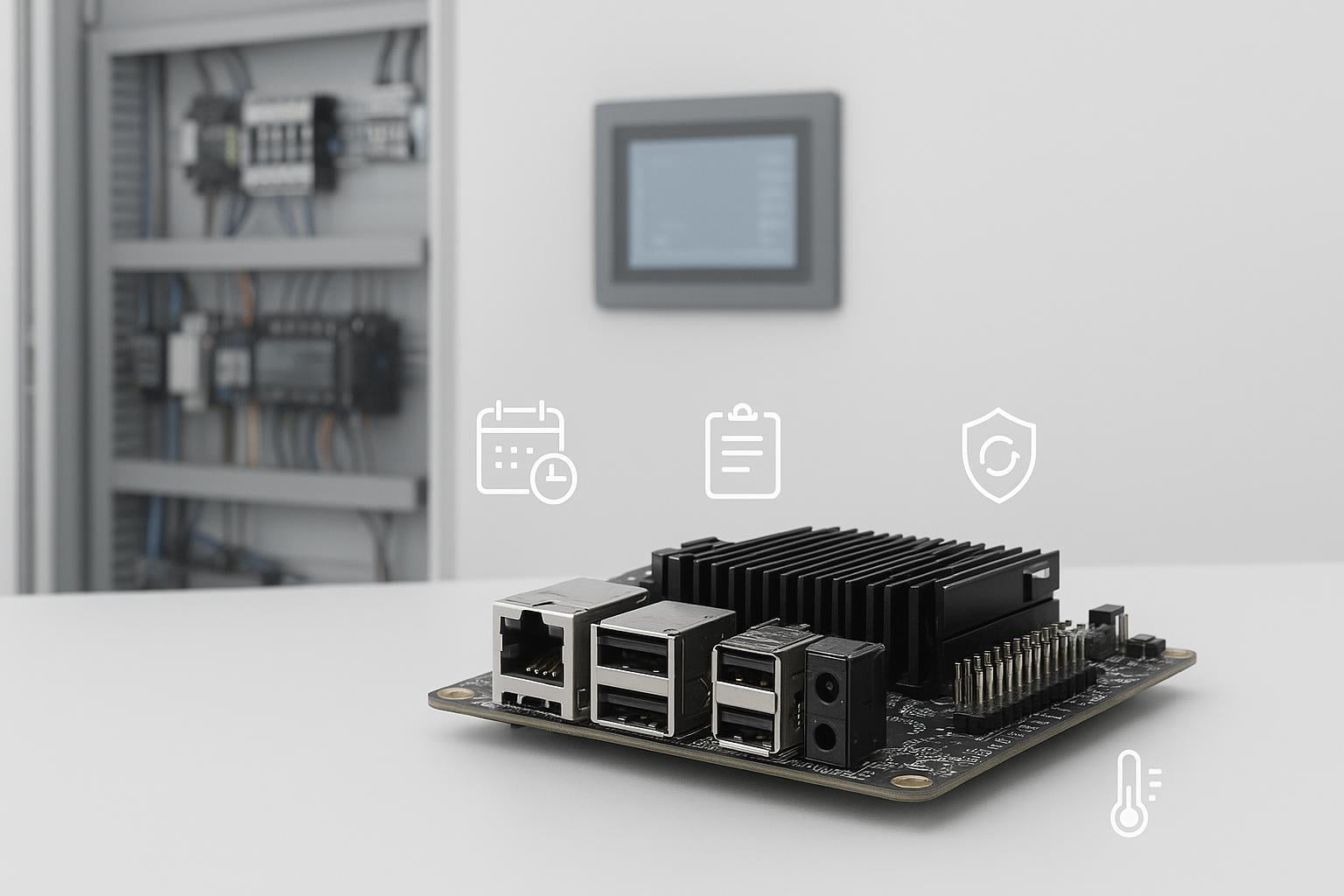
How custom SBCs reduce integration cost and design complexity
Mini case example (anonymized): European medical/healthcare equipment OEM
Starting point: SOM-based approach with multiple boards to integrate the display, touch, and camera stack.
Constraint: tight enclosure space and rising integration complexity.
What changed: LMTEK designed a Rockchip RK3568-based custom SBC to integrate the required peripheral set on a single board.
Outcome: freed enclosure space, shortened validation flow, lowered BOM cost, and improved serviceability.
Custom boards reduce integration cost mostly by removing “hidden work”:
fewer adapters, harnesses, and connector stack-ups
simpler assembly and test flows
clearer thermal and EMI behavior in the final enclosure
fewer revalidation cycles caused by workaround-driven changes
Custom SBC vs standard SBC vs SOM: how to choose
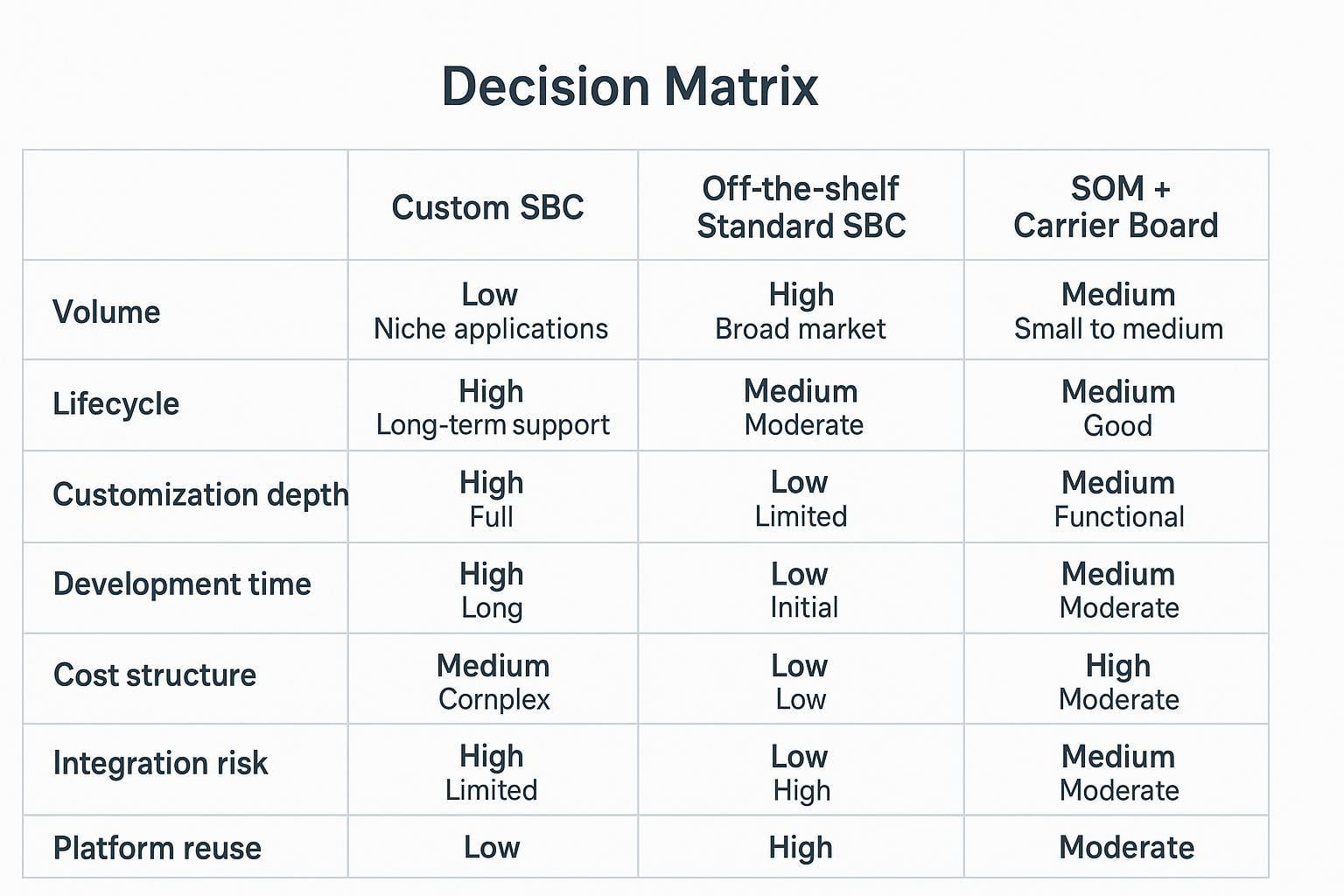
When to use a standard SBC
Use a standard SBC when the program priorities are:
rapid prototyping and proof of concept
low volume or uncertain demand
short lifecycle
requirements still changing (especially display and I/O)
If you can ship without complex adapters and the board fits the enclosure, a standard SBC can be the simplest path.
When SOM + carrier board may be more practical
A SOM + carrier board approach is often practical when:
you want a proven compute core and a faster schedule
you need custom I/O, power entry, or connectors on the carrier
you want platform reuse across multiple products
If you are evaluating SOM options for an OEM program, LMTEK’s overview of System on Module solutions can serve as a starting point for discussing module selection and platform reuse.
A related reference is LMTEK’s guide on selecting an ARM System on Module, which outlines how teams often compare CPU performance, interfaces, OS support, power, temperature, and lifecycle needs.
When a custom SBC delivers more long-term value
A custom SBC tends to deliver more long-term value when:
the interface set is clear and stable
volume is meaningful and predictable
the enclosure is space-limited or cable management is a risk
lifecycle is long enough that supply and revision control matters
integration complexity is high enough to drive recurring cost
Decision matrix: volume, lifecycle, cost, risk, and time-to-market
When do custom SBCs become more cost-effective?
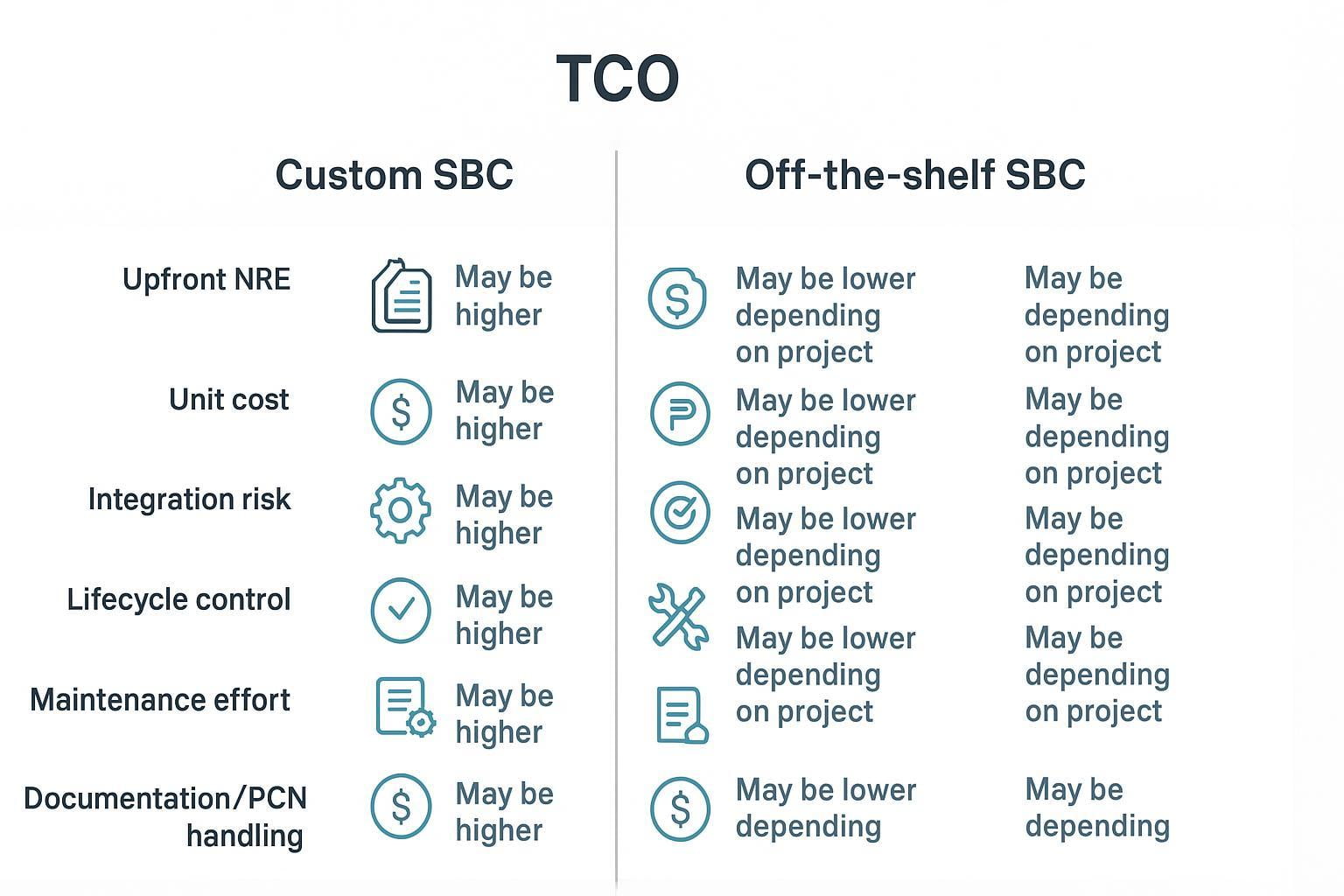
Custom SBCs may reduce long-term TCO when volume, lifecycle length, and integration complexity justify the upfront engineering effort.
A useful way to think about it:
NRE (non-recurring engineering): schematic/layout, bring-up, validation, documentation.
Unit cost: BOM, assembly, test, yield, rework.
Lifecycle cost: maintenance effort, planned revisions, field issues, redesign risk.
There’s no universal break-even quantity. Programs justify customization earlier when standard approaches require adapter-heavy integration, strict enclosure constraints, or frequent revalidation due to board revisions and EOL risk.
How custom SBCs support long-term supply and lifecycle planning
Long-lifecycle products need controlled change management. A custom SBC program typically puts more control around BOM ownership, alternates, and revision discipline.
Key items to confirm:
roadmap and expected availability
lifecycle-sensitive components and alternate-part strategy
PCN handling and revision policy (form/fit/function impact)
BSP ownership and update responsibility
How custom SBCs improve reliability in industrial environments
Validation and test approach you can ask for
Even when the technical fit looks good on paper, validation capability often determines schedule risk. Ask for evidence such as ISO 9001 processes, functional test fixtures, burn-in/aging, thermal-in-enclosure testing, EMI/EMC pre-compliance, and environmental testing via qualified partner labs.
Reliability requirements and what to test
Make requirements explicit and testable: operating/storage temperature, humidity/condensation, shock/vibration, duty cycle, and service interval. For “pre-compliance” and environmental validation, teams often map to standards families such as the IEC 61000 EMC standard series and the IEC 60068 environmental testing standard series.
How to evaluate a custom SBC supplier
Focus on whether the supplier can support the full stack you need (high-speed layout, power design, bring-up, BSP/drivers) and whether they can show practical validation and documentation deliverables.
What to prepare before starting a custom SBC project
A short requirements summary can save weeks:
workload, CPU class, RAM/storage needs
display/touch (interface, resolution, controller if known)
key I/O (Ethernet/RS485/CAN/USB/GPIO/UART) and peripherals
power input range and protection expectations
enclosure constraints, thermals, and environment
OS/BSP/driver requirements and update expectations
volume, lifecycle, and validation expectations
Frequently asked questions about custom SBCs
Is a custom SBC always cheaper than a standard SBC?
No. A custom SBC is often more expensive upfront because it includes NRE and validation.
It can reduce long-term TCO when volume, lifecycle, and integration complexity justify customization.
What is the difference between a custom SBC and a SOM carrier board?
A SOM + carrier board approach reuses a pre-validated compute module and customizes the carrier for I/O, power, and mechanical fit.
A custom SBC integrates everything on one board and can optimize for enclosure constraints, but usually requires more board-level design and validation effort.
What information is needed before starting a custom SBC project?
At minimum: workload/CPU class, key interfaces (display/touch/I/O), power input, mechanical constraints, OS/BSP needs, volume, lifecycle, and validation expectations.
Can LMTEK support display, touch, SBC, and HMI integration together?
LMTEK describes support for custom SBC development (including BSP/driver work) and integrated display/touch/HMI project delivery as part of its OEM/ODM custom solutions offering (see LMTEK Custom SBC solutions and LMTEK custom solutions).
A practical next step is to validate fit against your display interface, touch controller, mechanical constraints, and lifecycle expectations.
Discuss your custom SBC or SOM project with LMTEK
If you’re ready to start an evaluation, use the LMTEK contact page to submit your requirements.
References
Arena Solutions, Form, Fit, and Function
Renesas, Giving customers options: make or buy SoM and/or SBC
Mouser, SOM and SBC evaluation PDF
IEC Webstore, IEC 61000 EMC standard series
IEC Webstore, IEC 60068 environmental testing standard series